Harrisburg Senior Advisor
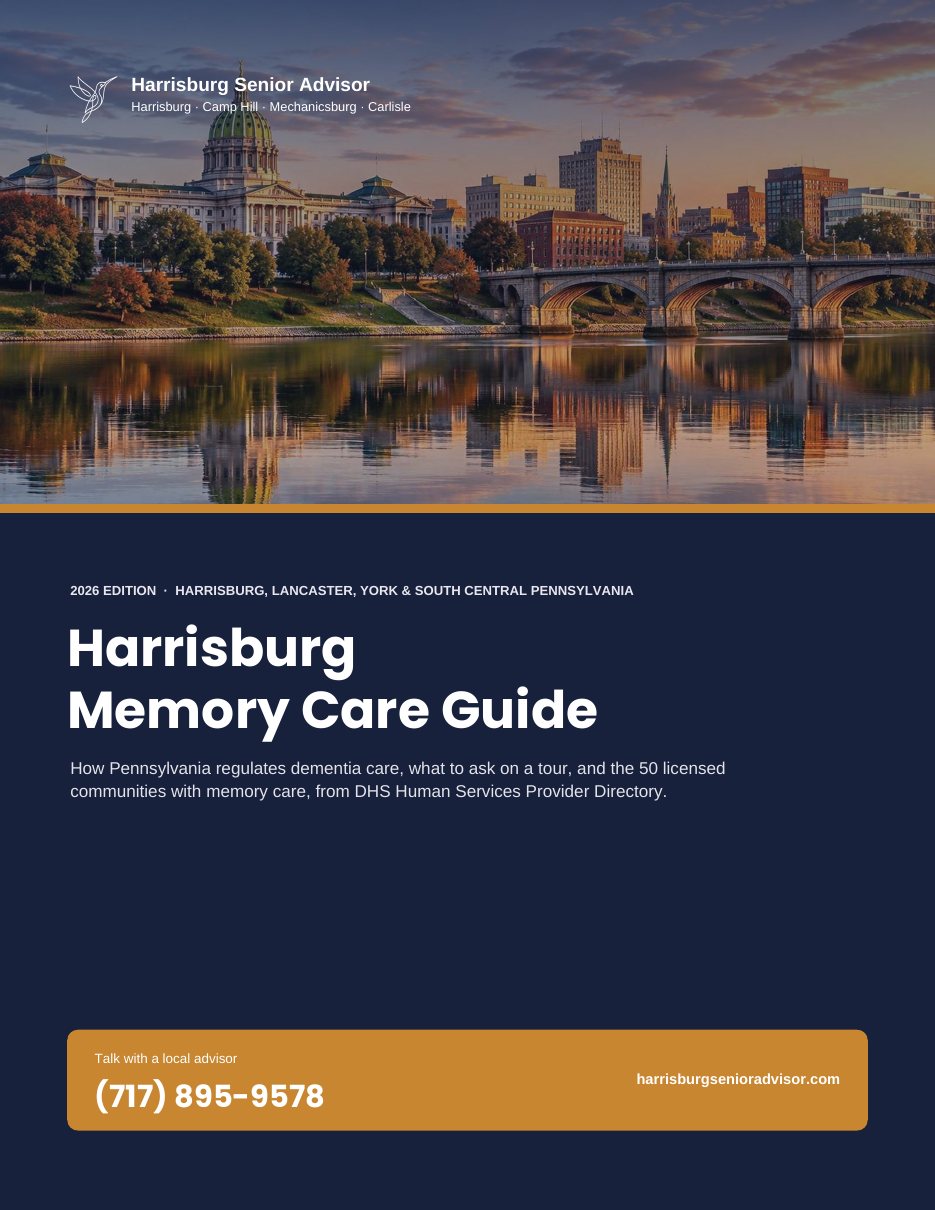
PDF (8 pages). Licensing data current to November 15, 2026.
What is in the Harrisburg Memory Care Guide?
It is short on purpose. Inside:
- A side-by-side comparison of assisted living and memory care.
- What Pennsylvania requires of a community that serves residents with dementia, with the rule citations.
- 50 licensed communities in Dauphin, Cumberland, Lancaster and York counties identified as offering memory care, with 1,777 secured beds.
- How memory care pricing compares with the Pennsylvania assisted living median.
- A printable checklist for memory care tours.
How is memory care different from assisted living in Pennsylvania?
The difference is the setting and the staff: Pennsylvania memory care adds a secured area and dementia-trained caregivers to ordinary assisted living.
| Assisted living | Memory care | |
|---|---|---|
| Typical resident | Needs a hand with bathing, dressing or medications | Has a dementia diagnosis and needs supervision |
| Building | Open floor plan, residents leave freely | Locked or alarmed exits, enclosed outdoor space |
| Caregivers | Trained for daily-living help | Trained for memory loss and behavior changes |
| Monthly cost | Lower base rates | Higher, for staffing and security |
How does Pennsylvania regulate memory care?
In Pennsylvania, licensed memory care means a locked unit inside a personal care home (a secured dementia care unit) or an assisted living residence (a special care unit). In the four counties only homes whose certificate shows that unit may lock residents in, and the rules add an admission screening and extra yearly training.
- License. The unit and its number of places are printed on the home's Certificate of Compliance (55 Pa. Code 2600.231 and 2800.231).
- Admission. A medical evaluation within 60 days documenting dementia and the need for a secured setting, plus a written cognitive preadmission screening.
- Training. Six hours of dementia-specific training each year for unit staff, on top of the twelve hours all direct care workers complete.
- Review. The resident's assessment and support plan are reviewed at least every three months.
How many Dauphin, Cumberland, Lancaster and York counties communities offer memory care?
Homes whose DHS certificate lists a secured dementia care unit or special care unit and its capacity, 50 licensed communities in Dauphin, Cumberland, Lancaster and York counties offer memory care, with 1,777 secured beds between them.
The largest clusters are in York (9), Lancaster (7), Mechanicsburg (7) and Harrisburg (5). 0 of them are small settings licensed for 20 residents or fewer.
What does memory care cost in Pennsylvania?
Pennsylvania has no published memory care median because CareScout does not survey the category. Unit rates in the four counties generally run above the $6,480 state assisted living median; get the unit rate and any care-level fees from each home in writing.
Which questions matter most when touring memory care in Dauphin, Cumberland, Lancaster and York counties?
Go at the end of the day, when the unit is at its busiest, and bring these questions:
- Can we visit at mealtime without notice?
- Is the rate all-inclusive, or base plus care levels?
- What did your last state inspection find?
- Can residents keep their own doctor?
- How are families told about falls or changes in condition?
Who helps a family in the four counties when a dementia unit placement goes badly?
The long-term care ombudsman, reached through the county aging office or the state office at 717-783-8975, advocates for residents without charge and can sit in on a care meeting if the resident agrees. Licensing complaints go to DHS at 1-877-401-8835, and suspected abuse to 1-800-490-8505 at any hour. The Alzheimer's Association helpline, 1-800-272-3900, is open to caregivers around the clock.
Would you rather talk it through?
Of the 50 communities with memory care, only some will have a bed this month. We can find out which.
(717) 895-9578More free downloads
Who publishes this guide, and how is it paid for?
Harrisburg Senior Advisor, a local senior care referral service, publishes the guide. It is free to families because communities pay us a referral fee when a family we referred moves in.
Nobody bought a spot in the guide. Its lists are drawn from the Pennsylvania Department of Human Services (DHS) record, and it is general information rather than medical, legal or financial advice.